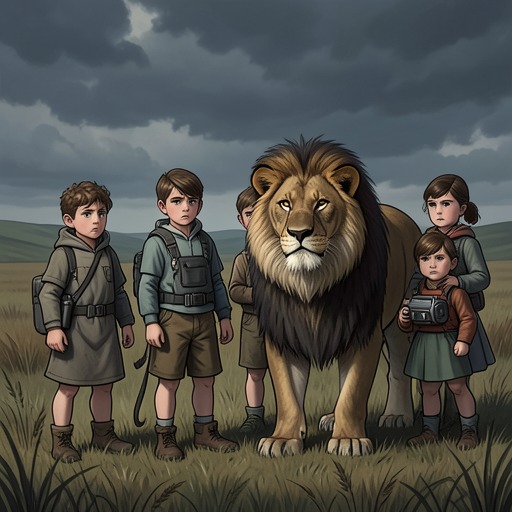
“The made-up things seem a good deal more important than the real ones”
The Silver ChairThe expression “The made-up things seem a good deal more important than the real ones” names the decisive reversal in the Green Witch’s attempt to undermine the travelers’ trust in Narnia: Puddleglum grants her hypothetical, then insists that even an imagined world of trees, grass, sun, moon, stars, and Aslan matters more than the world she offers as reality.
The Witch’s Challenge
The Green Witch has been speaking in sweet tones, but when Puddleglum touches her fire again, she turns on him in a loud, terrible voice and threatens to turn the blood in his veins to fire. The pain clears his head, loosening the magic that has been clouding his judgment. Instead of withdrawing his hand or accepting the Witch’s account, he recognizes what he thinks and begins to answer her argument on its own terms.
The Witch has tried to reduce the travelers’ remembered world to a dream or a game. Puddleglum does not claim that he can prove the existence of Narnia within the Witch’s black underground kingdom. He instead asks what follows if she is right: the imagined world still seems more important than the supposedly real one before them. The expression’s force comes from this deliberate concession. The argument does not depend on winning the Witch’s definition of reality; it judges the two worlds by what they contain and make possible.
A World Worth Choosing
Puddleglum makes the contrast concrete. Against the Witch’s “black pit of a kingdom,” he sets the play-world imagined by four children, a world that, in his judgment, “can make a play–world which licks your real world hollow.” The language turns a dismissal into a comparison of value: if the Witch’s account leaves only a dull, diminished existence, then the supposed game offers a better world to live by.
He makes that comparison an explicit choice. Puddleglum says he will stand by the play-world even if Aslan is not there to lead it, and will live as like a Narnian as he can even if Narnia does not exist. The statement is not a retreat from belief so much as a refusal to let uncertainty dictate his conduct. Faced with the Witch’s attempt to make her reality seem inevitable, he chooses the values associated with Narnia without demanding proof as the price of loyalty.
From Argument to Action
The declaration immediately changes the scene from debate to escape. Puddleglum thanks the Witch for supper and proposes that he, the two gentlemen, and the young lady leave her court at once, heading into the dark to search for the Overworld. He expects their lives may be short, but treats that prospect as a small loss if the Witch’s world is as dull as she claims. The argument therefore carries a practical cost: he is prepared to leave the safety of the court and face danger rather than remain within the Witch’s account of reality.
Eustace and Jill cheer Puddleglum, while the Prince suddenly warns them to look to the Witch. The expression is thus attached to an immediate shift in allegiance and action, not merely to an abstract reflection on imagination. Puddleglum’s willingness to affirm the better world even under the Witch’s challenge helps break her hold over the travelers and brings her threat into the open.